
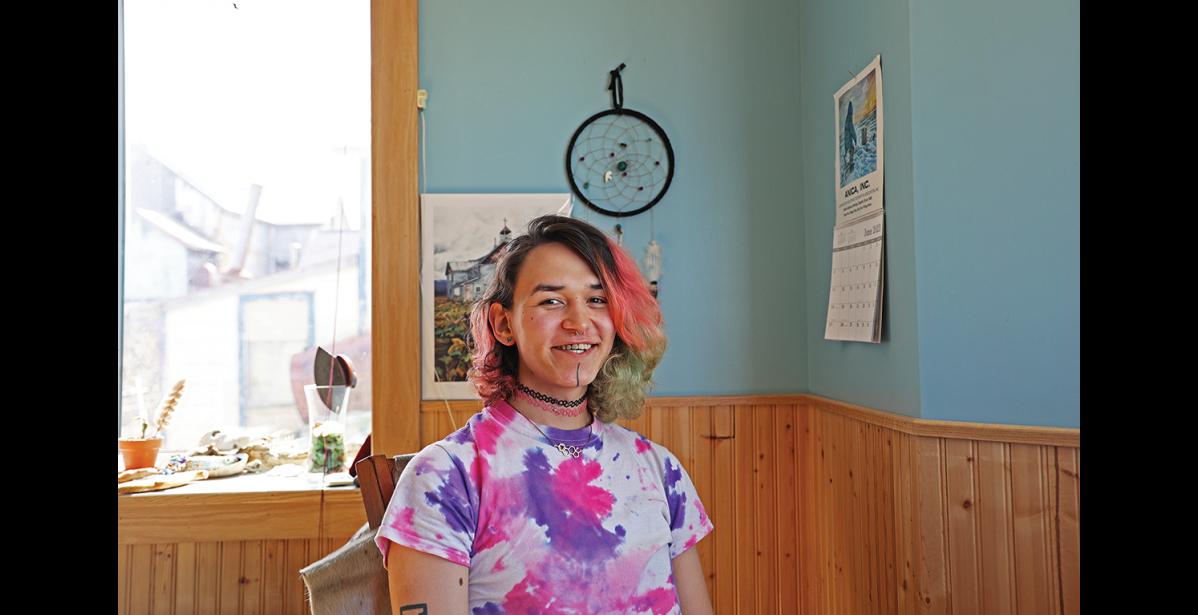
Apayauq Reitan screens documentary about her Iditarod run
Snow was blowing hard in downtown Anchorage on the morning of the Iditarod ceremonial start in 2022 as 24-year-old Iñupiaq musher Apayauq Reitan hoisted a blue, pink and white transgender pride flag onto a pole for her sled. She was headed to Nome as the first out trans woman to ever participate in the race.
Ahead of the race, she knew she would have to address her transition. She was not yet out when she last ran the Iditarod, as a rookie, in 2019. She decided that being very visible and open about her identity would be one way to advocate for trans rights. Over 12 days on the trail, she filmed a documentary about the experience. Last week, Reitan screened that film for an audience at the Katirvik Cultural Center in Nome.
“This is how I’m fighting,” she told the Nugget in an interview a day after the screening.
In the 16-minute film “Apayauq,” footage from the Iditarod trail is spliced with family movies of Reitan as a child. She is shown preparing subsistence foods in Kaktovik, where she spent her summers—and where her mother, Evelyn Anguyak Reitan, is from. She is shown with her family’s sled dogs in Norway, where she went to school—and where her father, musher Ketil Reitan, is from. In voiceovers, Reitan recounts how, as a kindergartener, she told people she wanted to be a girl when she grew up. That conviction was suppressed for a long time. After she finally learned about the existence of trans people, most media representations she saw showed trans women as the butt of jokes or murder victims.
In 2017, when she was doing qualifying races and figuring out that she was not cisgender, she found mushing to be a freeing activity. “Just being alone in nature when everyone’s wearing gear for 40 below, everyone looks the same,” Reitan told the Nugget. “That was nice. There was a lot of time to be able to just exist without gendered expectations, because there was no one around to have any expectations.”
She publicly came out in 2021. “I didn’t decide to be a woman—I decided to listen to myself,” she says in the film. Reitan had been studying photography in Trondheim and had the idea to make a documentary as she was preparing to run the Iditarod again. Initially, she wanted to do it all herself but decided to bring director Zeppelin Zeerip onto the project.
“Doing the Iditarod is hard enough,” she said. “Making a documentary is hard enough.” Doing both at the same time, even with help, proved challenging. She was running a couple of her own very experienced dogs, Apok and Kent, but most of the dogs she ran were young, from the B-team of Joar Ulsom’s kennel. She struggled with electronics that wouldn’t charge in the freezing temperatures. “My battery was completely dead during probably the best northern lights I’ve seen in my life on our way from Cripple to Ruby,” she said. She was ultimately the last musher to cross under the burled arch in Nome and was awarded the Red Lantern.
Now that the film is finished, Reitan said she’s very happy with the end result. She has been showing it to audiences at film festivals, and Nome was just one stop on a screening tour through Alaska. It’s also where her parents currently live.
Reitan is debuting her movie at a time when various measures restricting trans rights are being put forth across the state and country. Last week, Alaska’s state school board voted to advance a policy that would bar trans girls from participating in girls sports. Back in March, a screening of “Apayauq” in Juneau happened to coincide with a public hearing for House Bill 105, which was introduced by Gov. Mike Dunleavy. Reitan testified against the proposed law. The bill would require students to get their parents’ permission before taking a sex education class or participating in any program or club related to gender and sexuality. It would also require parental permission for students to change the name and/or pronouns they use at school. Under the bill, students would have to use bathrooms and locker rooms corresponding to the sex marked on their birth certificate. The bill has not become law, but just last week the Matanuska-Susitna Borough school board passed policies that were very similar to House Bill 105.
“The thing with 105 that is very concerning is that I didn’t learn about trans people in school, so I didn’t know that being trans was a thing,” Reitan said. “It’s a very isolating experience to think that you’re a freak, that society doesn’t accept people like you.”
She’s especially worried about trans kids who don’t have access to education about gender before they go through puberty, which was a painful experience for her.
“I didn’t know why that was such a hard part of my life, but now I know why it was hard,” she said. “I went through changes that some of them I can change and some of them I can’t change. I think it’s especially horrifying for trans youth who know that they’re trans and have to go through the wrong puberty, and they know that it’s wrong. Conservatives like talking about freedom, but they don’t like it when other people choose to live differently with their freedom.”
Many of the policies being introduced in Alaska and in other parts of the country are framed as protections for parental rights. Not all trans youth, however, can safely share their identity with their families. Reitan experienced acceptance from her family when she was ready to come out. Her parents attended her screening in Nome, and she said they have been very supportive.
“I was very worried that they wouldn’t accept me, and in retrospect that was very unfounded,” Reitan said. “My family accepting me was not a deciding factor. I’m very happy that they are accepting. But I would do it anyway even if I wouldn’t have my family anymore.”
Fears about losing family, she said, can keep trans people in the closet until they can make enough money to move away. And then they have to worry about facing employment discrimination and housing discrimination. In March, an Anchorage Daily News and ProPublica investigation revealed that the state’s attorney general directed the Alaska Commission for Human Rights to void protections for LGBTQ people in areas like housing and financing.
At one point in the film, Reitan reads aloud a hateful message she received online. Among other insults, the sender told her she should stay in Norway because she wouldn’t be accepted in her small Alaskan village. Being as involved as she is in advocating for trans rights, she said she’s never really surprised by anti-trans attitudes.
“I know what they think of trans women, and by extension, I know what they think of me,” Reitan said. “Whenever I would get something like that, it’s nothing new to me. It’s worse when it’s relatives or someone who could be a relative.” She suspects this particular message came from someone in Kaktovik using a fake account. Not all of her extended family and neighbors in the village are supportive, she said.
Reitan told the audience in Nome that her hope is to see as many trans people survive as possible.
The Trevor Project, a suicide-prevention organization for LGBTQ youth, recently published survey data which showed that more than half of transgender and nonbinary youth across the U.S. considered suicide in the past year.
Reitan often gets told that she’s brave for publicly sharing her experience, but she said that’s a quality she wishes she and other trans people didn’t have to possess.
“I don’t want to be brave,” she said. “I want to be safe.”