
Port commission discussion on storage space draws crowd
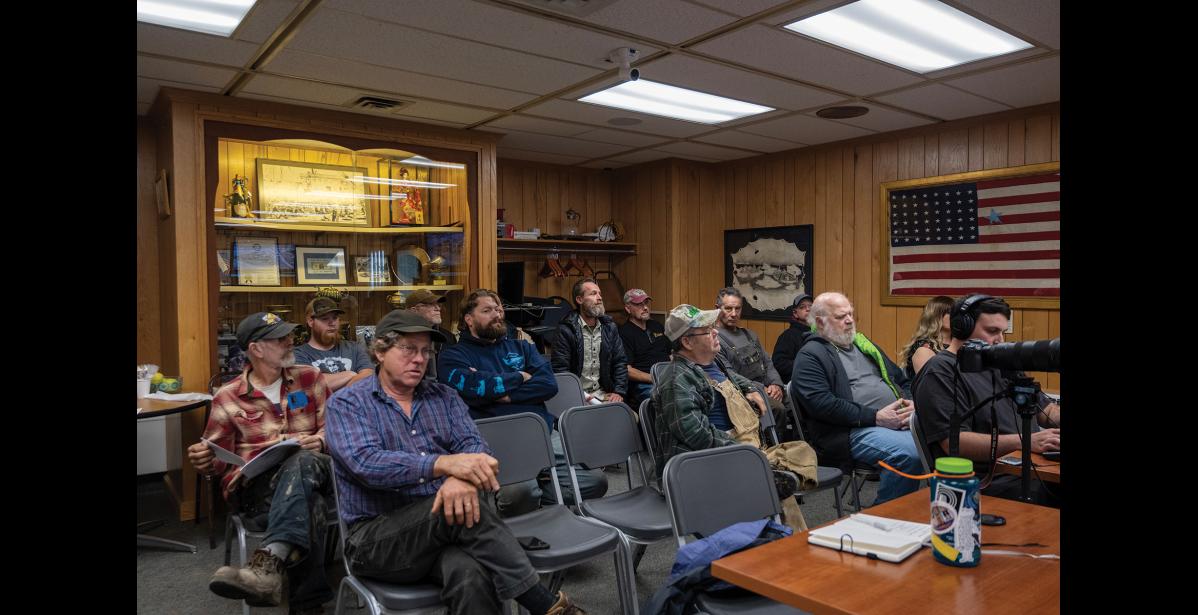
Last week’s meeting of the Nome Port Commission was well attended by those with opinions on what to do about the storage issue on the lower industrial pad at the Port of Nome. In a work session before the meeting, over a dozen port users piped up from the audience with varying options for what to do about the storage issue.
The port commission has been discussing the storage issue since July. Many vessels stored on dry ground have been there for years. The work session gave commissioners an opportunity to meet and discuss the topic with community members who use the storage space.
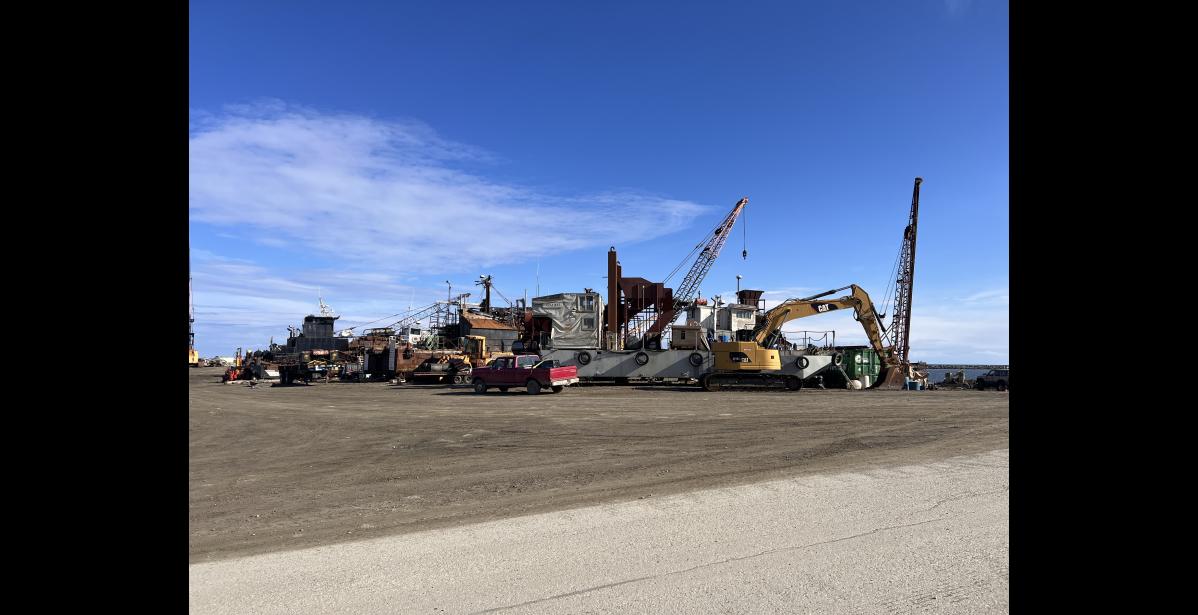
“If we just look at this pad alone right now, you see how far back all the vessels are,” said Harbormaster Lucas Stotts, pointing to a photo of the lower industrial pad. “There’s a whole tremendous amount of space here that’s just eaten up, that just kind of sits here.”
Most of the users agreed that vessels need to be moved to the south edge of the pad.
“We definitely want to remove things from the back so we can use that pad all the way up to the armor stone,” said Port Director Joy Baker. “But I think we are also trying to develop a long-term plan for vessels that haven’t been in the water in ten years, eight years.”
One attendee asked if the vessels taking up space had paid the fees. Yes, was the answer, but some of them had to be chased down for it. “It becomes more about the need to efficiently operate the freight on the available space in the summer versus the payment for occupying for 12 years,” Baker said.
Stotts pointed out that some facilities around the state have hard limits where boats can only be stored for one or two years, maximum. Some have sliding scales where the cost goes up every year. “All the facilities around the state are dealing with the same thing. It’s just everybody has different amounts of space available and handles it differently,” he said.
An attendee asked if there was space up the hill for more storage. Stotts responded that everything that could fit up there had already been relocated. The issue was the large vessels and equipment taking up space. “We’re not really talking about the one-off small little dredges or pickups. That stuff’s mobile,” he said.
Questions were raised about the large dredge located on the east side of harbor near River Street. Could it be moved back? It can’t be moved back all the way to the Mini Convention Center because that lot is used as the Iditarod dog lot.
“What we’d like to do is haul people out on the east side for winter because we have so many vessels that need to go into dry dock in winter,” said Baker. “We need to be able to maneuver into that entire stretch of pad, but the barge makes that difficult.”
Stotts pointed out that even if all of the vessels currently taking up more than their fair share of space were moved all the way to the south side of the lot, they would still be taking up an enormous amount of space. “What we’re trying to talk about is the long term,” he said. “What are the plans for these? Is that what, as a commission, we would like to do? Just allow vessels to stay as long as they want to, as long as they’re paying the bill and set a fee scale accordingly?”
The other issue, Stotts said, is that there isn’t really space elsewhere in the port. “We don’t want to reach the point that we have to deny customers. We want our space to be used efficiently,” he said.
“The other question pops up: once we get rid of all that, open up that space, then how long do we give people to either sit or start doubling their storage?” asked Commission Chair Jim West Jr.
“The majority of people are going to be out for repairs and back in. You know, it might take a season to do it. You know, you got short seasons up here,” said an attendee.
Baker said that the process to change the rates for storage and rules of the port takes time. “We’re not going to make anybody get out the next day,” she said. “But I think next summer we need to have plans for making a big shuffle down there, and the owners of those vessels have a plan.”
“I think vessels that have been in storage for 15 or 20 years in the backland areas are going to be the next layer to address,” she added.
One attendee said that it’s not a choice between moving vessels, a sliding scale of fees or a hard limit on years of storage, the solution could be all three with adequate notification.
During the later regular meeting, Stotts noted that the port employees would take the discussion into consideration and bring back proposals to the port commission. The commission itself is a recommending body to the city council, which sets the tariffs.
Stotts told the commissioners that September 23-26 should see the last Alaska Marine Lines barge, September 26 through the 29th will be Crowley delivering fuel and October 1 and 2 should be Delta Western delivering to Bonanza.
Baker said that Kiewit has begun removing armor stone off the top of the spur, part of the first phase of the Port of Nome expansion.
Sheffield asked again about the prospect of Nome having some type of port authority, saying that it seemed like a way for the Port of Nome to have access to more funding options.
Baker said that the city already has authority to own, operate, maintain, regulate and fund the port. A port authority would not expand those powers and might in fact cause them to lose some control of the port. “It becomes a public corporation beyond the municipality’s control,” she said, referring to a port authority.
Earlier in the meeting, Sheffield said she attended the groundbreaking ceremony hosted by the Army Corps of Engineers on September 2, and noted that it was not a public event. During comments, she said that it seems like the port expansion project needs to be more transparent. Sheffield said that she had been hearing from the general public that they felt the port would not help anyone in Nome and that people did not know much about the project. “It was shocking to me to see that no one’s there at that shovel ceremony, which is a pretty big deal,” she said. “This is the port of Nome, right? This is for the region. People have been hearing about this. We can do better. So that’s my comment on that –communication transparency, more inclusion as we move forward.”
Lean commented that the salmon runs in Nome were poor this year and noted that some spawning beds near town have been damaged. “The miners there by the Moonlight Springs have wiped out the spawning beds,” he said. “Frustrating for me. I spent the last 25 years trying to keep that run going.”
The next meeting of the Nome Port Commission is scheduled for October 15 at 5:30 p.m.