
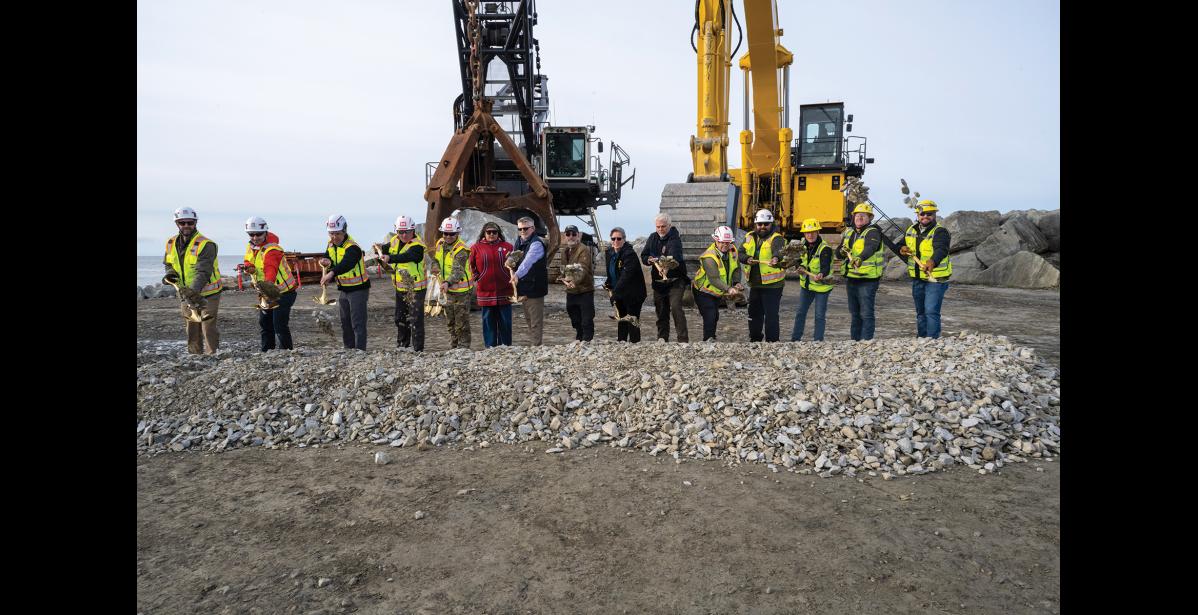
US Corps of Engineers officiates port expansion groundbreaking ceremony
On invitation by the U.S. Army Corps of Engineers, the federal entity overseeing the Port of Nome expansion project, City of Nome officials and representatives of the phase 1A contractor Kiewit, gathered at the causeway on Wednesday morning, Sept. 2 for a groundbreaking ceremony.
Several Corps of Engineers representatives came from as far as Hawaii to mark the occasion, which was announced only a few days prior. Present from the City of Nome were Mayor Ken Hughes, Interim Port Director Joy Baker, City Manager Lee Smith, Nome Common Council Member Maggie Miller and Port Commissioners Jim West Jr. and Gay Sheffield.
Against the backdrop of a huge American flag, an enormous crane and another piece of big equipment holding in its claws armor stone dwarfing the people lined up in front of it, Jathan Garrett, Deputy Chief of Programs and Project Management with the Corps’ Alaska District, led through the brief event.
After speeches by the Corps’ Alaska District Colonel, Mayor Ken Hughes, Interim Port Director Baker and Kiewit’s director of infrastructure Pat Harrison, the group took to golden shovels, especially made for the occasion and engraved with the words “Port of Nome Modification Phase 1A”, posed for a photo and pitched rocks to symbolically start the project.
Col. Trujillo summarized the project, which will add a 1,200-foot causeway extension with about 600 feet of dock face to the existing port, saying that the extension will improve access to the existing harbor, provide additional protection and relieve congestion at the existing port. “Our work here will improve economic efficiency, enable greater freedom of movement and ensure safer transit for vessels in and around Port of Nome,” Trujillo said. “This community is a key regional hub in Western Alaska, underscoring the importance of a safe and efficient port here in Nome.” In the changing Arctic, an expanded harbor has far-reaching implications for economic vitality in the region, he added.
Mayor Hughes said he was delighted to be the mayor of Nome at this time, “to see the dreams of our residents slowly inch towards the beginning of a completion.”
He said there is opportunity in the Arctic and that “this port will be just the beginning of what our region can provide not just to the state but to the nation.”
“Once this is done, I guarantee, we gonna need another 3,000 feet of runway and a surface connection to the rest of America,” he said. “We need to think big, beyond the port, we need to start dreaming big.” He acknowledged that growth and development can be a “challenge” for residents, but “we can’t really stop it,” he said.
“All we can do is get out in front of it, attempt to control it, so that we control our destiny, our future and to have control over the growth and development,” Hughes said.
“I would urge everyone in our community to embrace and participate as much as possible in planning and thinking about our future, because it’s only if we can all work together, as this project shows, that we can truly accomplish the goals that we have for our region, our state and our nation,” Hughes ended his speech.
Kiewit Infrastructure Project Director Pat Harrison gave a glimpse of the challenges of the sheer enormity of this project. He said that Kiewit has a long history with Army Corps projects, dating back to a time before statehood. They were involved in the construction of the Early Warning Radar Sites, like White Alice, and previous port expansions in Nome. He pointed to challenges such as the short construction season, weather limitations, complicated logistics and supply chain issues and limitations or constraints regarding materials or material sources.
He then cited staggering numbers: “We estimate that Phase 1A will require over 380,000 craft hours to complete the project,” he said. “That translates to 80 man years, given the construction schedule that we have.” They will place over 500,000 cubic yards of rock. “We will mine over 3 million tons to make that rock. We will haul over 26,000 loads of rock into the port,” he added. They will need cranes, pickups, loaders, excavators, trucks, altogether over 150 pieces of equipment to deliver the project. Most people look at the project, and they think it’s a rock project, and it is, he said. But he also said there is a significant sheet pile bulkhead associated with this. “The sheet pile themselves represent about 5 million pounds of sheets for the bulkhead that will go in. The temporary steel associated with supporting those sheets represents about eight and a half million pounds of temporary steel. Temporary steel for other miscellaneous activities exceeds a million pounds,” Harrison said. And in addition, Kiewit constructed a186-person temporary housing facility to accommodate all the workers, at 6th Avenue and Steadman St. That is where the group moved to next, after the ceremony, to have lunch that was served buffet style, for a $5/plate donation.
In a Facebook post celebrating the groundbreaking, the Corps stated erroneously— and later corrected the statement— that tribal leaders were present. Asked if the local Tribal governments Nome Eskimo Community, King Island, Solomon or Council were invited, a spokesperson for the Corps said that the project manager reached out to the Village of Solomon but did not hear back. He added that there was no set list of invitees.
Asked about the timing, the spokesperson wrote that “the date of Sep. 2 was chosen to align with the busy schedules of senior leaders from USACE and celebrate the start of construction before the winter season.”