
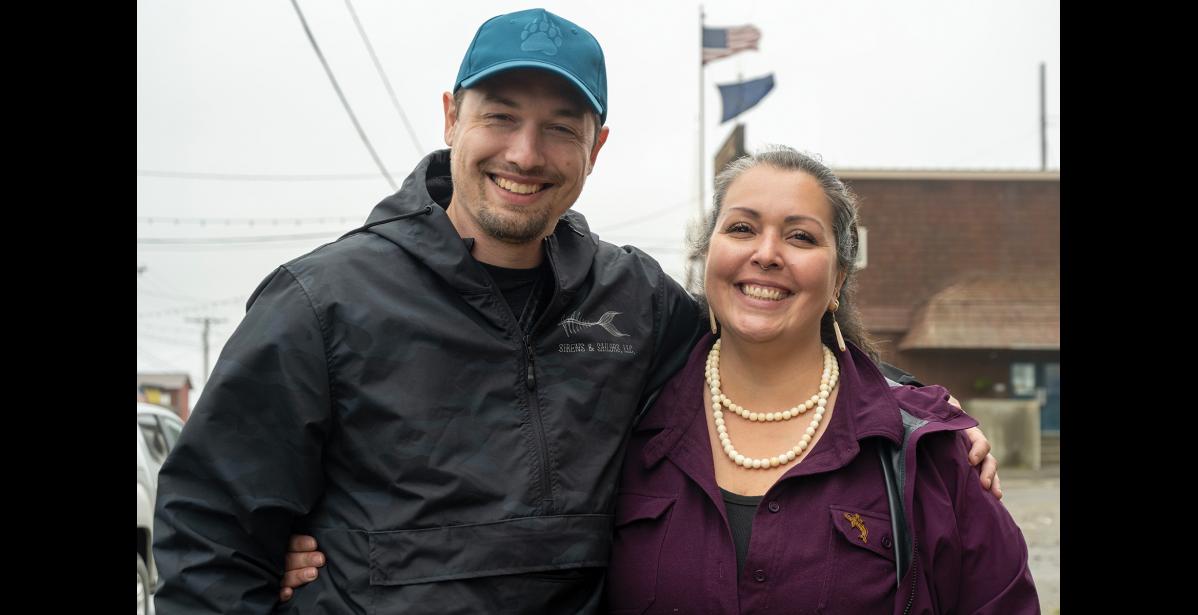
Gubernatorial candidate Meda DeWitt and running mate make campaign stop in Nome
Candidate for governor Meda DeWitt and running mate Chris Steere visited Nome August 2 and 3.
DeWitt, originally from Wrangell and Yakutat, is running as an independent candidate in a crowded field of 17 vying for the governor’s office. Steere is from Unalakleet. Both currently live in Anchorage.
DeWitt is a Lingít traditional healer, community and political organizer, president and board chair of Yakutat’s village corporation and was the chair of the Recall Dunleavy campaign. Steere has worked as an educational tutor and served in the military.
DeWitt describes their campaign as “Alaskans first” focused. “We don’t have to buy into the national party politics and the squabbles and things, and we don’t have to take direct orders from party leaders and that are out of the state,” she said. “We are both Alaska Native, and we are very committed to the state and having a viable future and a viable present for our children and communities.”
DeWitt’s top priorities are centered around creating a sustainable, self-sufficient Alaska, an approach she calls “holistic.” More specifically, she wants to return manufacturing and food production to Alaska, invest in education that enables Alaskans to work in-state and reduce fuel costs by refining fuel here.
She wants to close the so-called S corporation loophole, which would have companies licensed as S corporations or limited liability companies to pay corporate income tax for profits earned inside Alaska. She wants to keep production and manufacturing in-state. “That means that the dollars are made here and spent here and circulate here. There’s so much money that leaves out of the state. It’s just absolutely ridiculous,” she said.
“It is the most important thing: ending corporate welfare, making the extractive industries pay their due taxes, and by hiring Alaskan workers, that money recirculates back into the economy instead of just leaving with the resources,” added Steere.
DeWitt emphasized local manufacturing and production not just as a way to invest in the economy but as a survival tactic. “If there was some reason a halt to the shipping, we’d be running out of prescription medications, running out of food in the stores in a matter of days,” she said.
On Sunday at Milano’s, DeWitt and Steere met at a campaign event with a diverse group – community leaders, ministers, behavioral health workers and more. “They were sharing the same challenges, of trying to find good work, stable housing, not being discriminated at in work or schools,” she said. “And really the income of the community, the infrastructure is also decaying. The education is not where people want it to be.”
She said that everywhere she goes, people bring up fuel cost, cost of food, access to subsistence resources, lack of housing and lack of job opportunities. She said another throughline is discrimination. “A lot of discrimination happens too in the medical community around our Indigenous people, especially people who are very dark in skin or have heavy accents,” she said.
DeWitt pointed out that Alaskans view themselves as independent but are reliant on outside goods and industries. “We ship in 95 percent of our food and goods. We even ship in our consumption of oil and gas when we have oil and gas here,” she said. “We have other resources here, natural abundance here that we can be working with in a way that’s more ethical, and we don’t have to choose between destroying large tracks of land and having wealth.”
Asked about their position on mining projects like Graphite One, they said that development can provide opportunities for Alaskans and help the state become more independent. “For us, the land and the sea and the wildlife are religiously sacred, but at the same time, we can have responsible development of our infrastructure, where we can respect those things without destroying or poisoning the land, right?” said Steere. “If we can do it in ways that make sense and are economically viable to the maximum benefit of Alaskans then we are absolutely for that kind of progress and development. But it has to be done right.”
“It means smaller, more intentional activities. It means not having open pit water, like open pit tailing ponds above watersheds,” added DeWitt. “It means having a plan and bonds for remediation before the project even starts.”
Steere said that the campaign’s priorities are all interconnected. “We talk about food security, energy independence, healthcare, and kind of maybe not as much, the data sovereignty. Those are all things that go together,” he said.
DeWitt doesn’t think Alaska needs to choose between Alaskan culture and western science. “We can have both. We can [have the] best of everything we want,” she said. “It’s about efficiency, right? And managing with intention, prevention, care. We can do that.”
DeWitt and Steere want Alaska to be self-sufficient and rely less on federal funds. “We’re looking at these tariffs, we’re looking at these unnecessary foreign wars,” said Steere. “If the federal government just decides legally or otherwise that they’re not putting in the funds anymore, then it’s like, ‘Where are we? What are we supposed to do?’”
“Subsidized shipping, federal funding for education and in other programs, Medicaid. There’s all kinds of ways that Alaskans have been made dependent on the federal system,” he added. “That’s one of our things: transitioning instead of being an extraction colony, building ourselves up so we can operate like an independent nation.”
They’re committed to supporting rural Alaskans and Alaskan culture. “Rural Alaska is part of our soul as Alaskans. It defines us as what’s unique, special, and we have really strong cultures here,” said DeWitt.
As Alaska transitions from the industrial age into the technological age, DeWitt says there’s a separation of connection of land and culture. “We can work to actually start to invigorate it and bring it back because people, they’re experiencing a lot of grief, a lot of loss, a lot of loneliness, disconnection,” she said. “There are ways to actually remedy that and help people get connected and improve our baseline mental health across the state.”
DeWitt said she felt it was time for her pursue office. “I’ve had people ask me to run for a long time, and my children just weren’t old enough. I wasn’t ready yet,” said DeWitt. “Our kids are leaving the state, you know, or people are aging out, people are moving out of the village. Our state’s in decay.”
DeWitt admits she does not have experience as a publicly elected official but said she isn’t nervous. “I believe that coming into this space and having somebody that actually wants to communicate, be present and work with [the legislature], we can get so much done so quickly,” she said. “I am a hard worker, and I do it for the people, and so my anxiousness just is in that space of not wanting to let people down.”
She also pointed out that she has face recognition from her work as an educator, healer and advocate. “The Meda that you know and love is the same Meda that’s on the ballot,” she said.
DeWitt said she and Steere take a more traditional approach to campaigning, instead of fundraisers and speeches. “Come in, present ourselves, be transparent, open, available, answer the questions, share the policies, and rebuild that relationship with a new lens,” she said. “It’s a way of organizing in native communities that I don’t think any of the other candidates understand.”
She believes there are enough votes in rural Alaska that — if people turn out — she can make the top four and advance to the general election in Alaska. “Nome is notorious for having underrepresentation at the polls, especially Alaska Native people, and we really want them to know that they do have power,” she said. “And I know it doesn’t feel like it all the time, but this is one of the ways that they can exercise their free will in this democratic process and see real change.”
Steere said that his and DeWitt’s Native Alaskan background means they’re going to stick around. He wants his kids and family to be able to thrive for generations. “These problems are everyone’s problems,” he said. “And even though we have this investment, we are here for all Alaskans.”
The primary election is August 18. The top four vote-getters in each race will advance to the general election in November.