
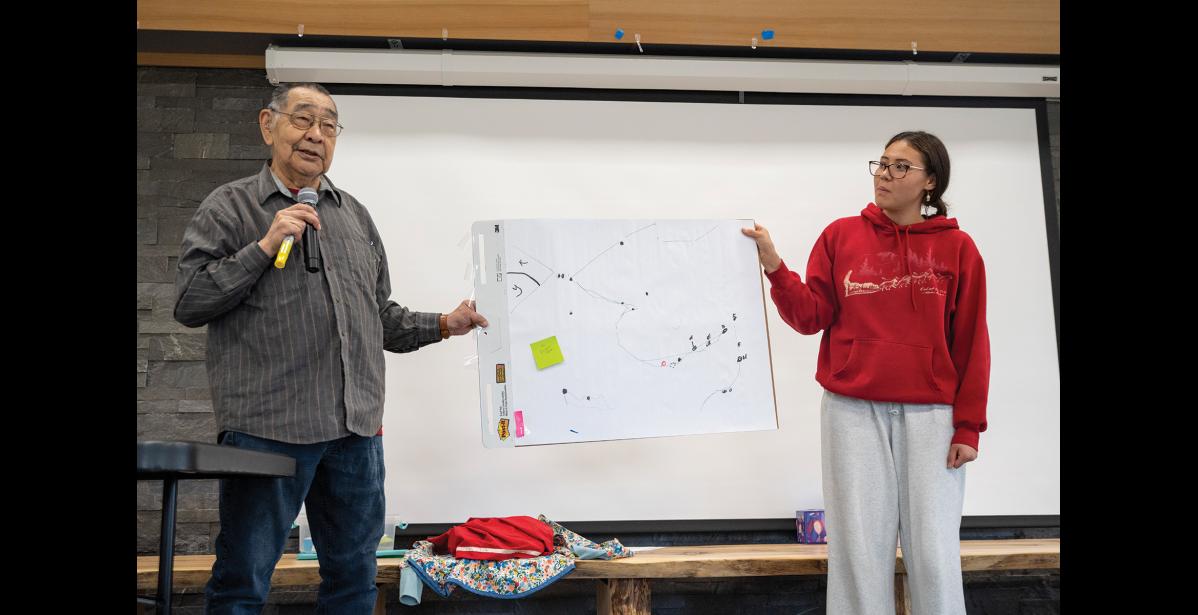
Let's speak Inupiaq: Attendees gather for Inupiaraaqta 2026
On September 10, a row of ANSEP Acceleration Academy students seated in the King Island Native Community Hall introduced themselves hesitantly in Inupiaq, listing off the names of their parents, grandparents and where they lived. The students were attending part of Inupiaraaqta, an Inupiaq language conference hosted by Kissaq Kingikmiuraguqtuat.
Inupiaraaqta means “Let’s Speak Inupiaq.”
From the stage at the front of the room, Elder Richard Atuk, Inupiaq name Knownuk, spoke to the students, explaining that learning their language is the avenue to learning their history and culture. “The reason it’s important to study language is tied directly to your history, as far as you can reasonably take it back to learn about where you came from, where your parents came from, what they were doing, and why,” he said.
“From learning our history, we start learning things about ourselves,” he added.
Kissaq Kingikmiuraguqtuat is a nonprofit dedicated to documenting, preserving and speaking the Seward Peninsula dialects of Inupiaq, particularly the Kiŋikmiut (Wales) dialect. Around 2017, the group began meeting in person, during the pandemic, they switched to meeting on Zoom. They hosted and organized the conference, which was funded by a grant from Native Movement and from in-kind donations.
Many members of the group were present at the conference, in addition to Elders and community members from around the Seward Peninsula. Instead of lectures and lessons on language and sentence structure, the learning at the event flowed more like a conversation between experts and between those at earlier stages in learning.
During one discussion on how to welcome people to a village or dwelling, Elders around the room provided their own pronunciations and translations. As the discussion went down the line, speakers added new meanings to the words and phrases and expounded upon the definitions.
Atuk does not approach teaching with a Western approach, where one person lectures a group of students. Instead, it’s more of a discussion. “I want to learn about language, not that I want to speak it,” he said. “How is it structured? What does it do? How is it important? All those questions that I know young people have, people like me still have them.”
Debbie Izhraaluk Atuk, Richard’s daughter, said that the way her father approaches learning and teaching Inupiaq is through consensus. Kissaq Kingikmiuraguqtuat has a database on their website with the names, definitions and pronunciations of hundreds of words in the Kiŋikmiut dialect of Inupiaq, as well as counterparts in other dialects: Kotzebue, Utqiagvik, Shishmaref and Kawerak.
Before Atuk adds an entry, he wants to verify the word with other speakers of the dialect. “We’ve had so much interruption with the language that he’s of the opinion that we all kind of need to work together,” said Debbie. “He’s making an attempt to build consensus so that it’s not this one person’s point of view that’s being shared and taught.”
The three-day conference featured this in practice, where the learning model was collaborative, with speakers sharing definitions and pronunciations. “I think he has, in a roundabout way, reestablished a traditional village model of teaching,” said Debbie Atuk. “Which is to say, there are many people who are contributing to saying what’s right, and there’s no one person saying, ‘It’s my way.’”
Richard Atuk is focused on preserving and sharing the Kiŋikmiut dialect because it’s the dialect connected to the land and culture he grew up with. His people, he said, were subject to instantaneous change, where one way of living was replaced overnight. When people stopped speaking the language of their village, they were cut off from the history and from that understanding of their own culture. “It took away the teaching of who we are, where we came from,” he said. “It’s like all of a sudden, we were aliens in our own land, and that idea has bothered me all my life.”
Young people who did not grow up speaking their language were cut off from Elders who spoke it as a first language. The conference was an opportunity to rebuild those connections. When participants broke into groups, each group had an Elder who spoke the language expertly.
“The important thing is start to start bringing that back together,” said Richard Atuk. “In other words, what we’re doing today: young people with old people.”
Annie “Anaŋalutaq” Conger, originally from Brevig Mission and now living in Nome, speaks Inupiaq as a first language. She said that what language someone is speaking helps identify where a person is from, their family history and their village history. Conger was a teacher for many years. “My tongue slept for many years because I taught in English,” she said. “Then once the Inupiaq immersion class opened up at the elementary school, they couldn’t find anyone. Then I was happy to come back to teach.”
Getting to teach Inupiaq helped her end her career happy. “I taught these little ones how to speak, in fact, and know who they are,” she said. “What their Native name is also identifies them: who they are, which family they came from.”
Through the three days of the conference, attendees from across the Bering Strait region and across the country learned language, conferred on the meaning and origin of words, taught each other stories and simply spoke Inupiaq together.
Debbie Atuk explained that language encodes relationships: between people, between relatives and with the land. “We can’t really expect our people to feel whole if they are missing a big part of who they are because their parent or grandparent or great grandparents came from this very distinct way of living,” she said. “The language encodes, as he [Richard] says, who we are.”
It’s a pragmatic view of language and identity, built on experience. “The language is built on the landscape and people observing it and seeing it over time,” she said. “Seeing who used it and what animals were there and how the ice formed and when the ice formed and how to look for changes in the environment and to understand when animals were going to come back.”
Even though the past has pain in it, looking at those gathered around for the conference gave Richard Atuk hope. Working with young people who are hungry for knowledge helps him see the path forward. “I think it’s repairable, but it will take a lot of time, a lot of patience, and we have some real challenges,” he said.
Correction: The first sentence was corrected to reflect the identification of "high schoolers" to "ANSEP Acceleration Academy students."